
-
Make Mass Great Again
It’s not just us!
More parishes are discovering Mass the way it was meant to be celebrated, returning to the authentic teaching of Vatican II. Take some time to watch this episode of The Catholic Talk Show, where they discuss “5 Ways to Improve the Novus Ordo Mass.”
How many of their suggestions do you see here at St. Mark every Sunday? Did they miss anything?
-
Renovating the Renovations
One of the curious things about late-20th century church “renovations” is the sheer amount of work that went into hiding or eliminating many of the beautiful elements which marked these older buildings. These modernizations have not aged well, and a lot of time and money is now being spent to undo the changes and restore these buildings to something resembling their former dignity. For another example of this, look at the before-and-after shots in this article from the Liturgical Arts Journal.
As we consider the future of our own church building at St. Mark, let’s try to think beyond contemporary trends and imagine how what we do will be received by future generations.
-
What’s a “Catholic” Education?
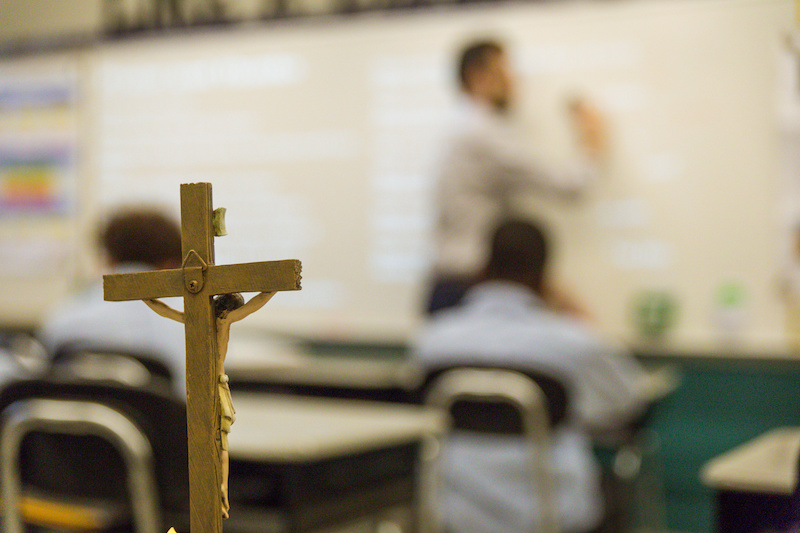
But is a Catholic school really just an excellent public school? Is that all Catholic education now amounts to—secular success?
Paul KrauseAs St. Mark parishioners know, we have for some time been pondering the future direction of the parish, and one possibility that has come to the fore is to build a school on our campus. And not just a Catholic school, but a classical Catholic school.
(more…) -
Music Spotlight: Paul Jernberg
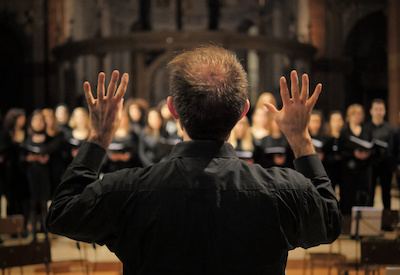
In order for sacred music to reach its full stature, composers and musicians need to exercise true artistry, in which knowledge, inspiration, and skill all play a vital role in creating works of dignity and beauty.
Paul JernbergYou may not have noticed, but the past 30 years have seen the beginnings of a kind of renaissance in Catholic sacred music. It has been very slow and has largely gone unnoticed at the parish level, but it’s real and it’s bearing fruit.
(more…) -
Music Spotlight: “Ave Maria” by Michael John Trotta
Today, our music spotlight comes courtesy of our excellent music director, Diana Corliss:
This weekend, we will be singing two beautiful pieces on Mother’s Day in honor of our Blessed Mother.
At the 10:00 am Mass, the choir will be singing a setting of the “Ave Maria” by Michael John Trotta. It has a soaring and tender soprano solo that reminds me of the Blessed Mother hearing our prayers and interceding for us with her motherly love.
We will also be singing the “Salve Regina” at the end of every Mass this weekend.
Links to recorded versions of these pieces are included below. Better yet, come to the 10:00 Mass this weekend and hear our superb choir!
-
“Form Follows Function”: How We Got to Where We Are

What is clear… is that forcing modernist principles of building design upon unwilling church congregations and passing them off as if they were principles of the Council simply must stop.
We’ve talked a lot on this blog about what church architecture ought to be; that there is a “theology of architecture” developed and passed down over centuries that should inform how our church buildings are designed.
(more…) -
Music Spotlight: John Sheppard

Today, I thought I’d share one of my all-time favorite pieces of sacred music: a setting of In manus tuas by English composer John Sheppard (ca. 1515—1558). For what it’s worth, I actually consider this one of the most beautiful pieces of music I’ve ever heard.
(more…) -
A Deep Dive Into Liturgical Reform
The Church’s existence lives from proper celebration of the liturgy, and the Church is in danger when the primacy of God no longer appears in the liturgy nor consequently in life.
Pope Benedict XVIIf you would like more insight into the reform of the liturgy, both before and after the Second Vatican Council, this article from Adoremus is worth your time. In it, the author traces liturgical developments in the 20th century through the eyes of Joseph Ratzinger, later Pope Benedict XVI.
(more…) -
“Ad Orientem” Revisited

There is only one inner direction of the Eucharist, namely, from Christ in the Holy Spirit to the Father. The only question is how this can be best expressed in liturgical form.
Joseph Cardinal Ratzinger, 1986There continues to be considerable misunderstanding of ad orientem worship by many Catholics, which is unfortunate, because there is so much depth of meaning and rich theology involved in the simple gesture of the priest facing the same direction as the people during Mass.
(more…) -
Gregorian Chant—a Brief History

One of our goals at St. Mark has been to gradually restore Gregorian chant to its rightful place in the sacred liturgy. This is specifically in response to the call of Vatican II: “The Church acknowledges Gregorian chant as specifically suited to the Roman liturgy; therefore, other things being equal, it should be given pride of place in liturgical services” (Sancrosanctum concilium, 116).
One might be tempted to think that there was an unbroken tradition of Gregorian chant in the Roman liturgy right up until the 1960’s, when “everything changed.” But that’s not quite right. It turns out that Gregorian chant fell on hard times from the about the end of the Middle Ages up until the mid-19th century. It’s ironic that it was that other venerable liturgical musical form, polyphony, that worked to undermine the purity of chant and initiate its decline.
(more…)
Home
1–2 minutes

